
Django For Everybody

- Description
- Curriculum
- FAQ
- Notice
- Reviews
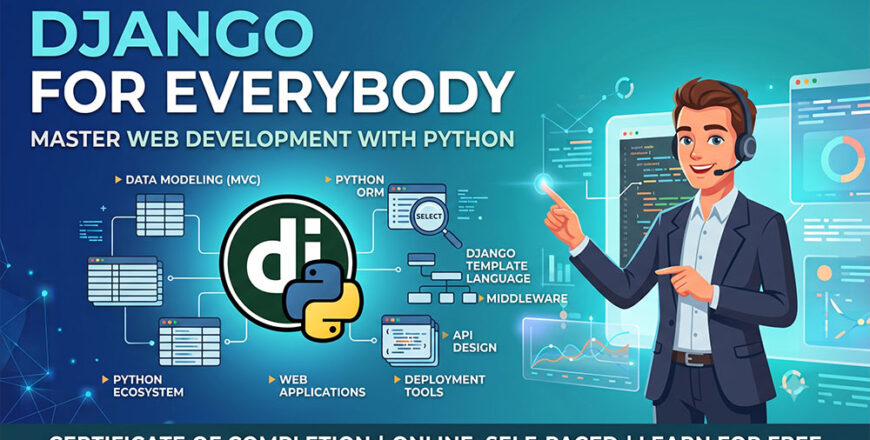
Take your Python programming skills to the next level by mastering Django, the high-level web framework that powers some of the most data-rich, scalable applications on the internet.
In this comprehensive course, you will dive into full-stack web development using the Model-View-Controller (MVC) architecture. You will learn to build and deploy fully functioning Django applications from scratch, style them with modern HTML/CSS, and implement native authentication features like user logins, sessions, and cookies.
Moving beyond basic static sites, you will learn to construct dynamic data models using backend SQL databases, process complex data formats like JSON, and add real-time interactivity using JavaScript, jQuery, and Ajax. Whether you are running local environments on Linux or pushing your final code into cloud deployment, this course builds the foundational stack needed to become a versatile web application developer.
Course Acknowledgement
 Generiss Academy gratefully acknowledges Dr. Charles Severance (widely known as Dr. Chuck) for authoring the PostgreSQL for Everybody curriculum. This educational content is generously provided free of charge and is licensed under a Creative Commons License (CCL), supporting the global mission of open-access education.
To explore more of his educational initiatives, open-source projects, and learning resources, visit his official website at online.dr-chuck.com.

Course Duration
-
Estimated Time: 5 to 7 weeks (Self-paced, flexible learning structure)
-
Format: 100% online with interactive video lectures, syntax-checking code sandboxes, and hands-on cloud deployment projects.
Career Paths, Roles, and Opportunities
Django is a preferred framework among global startups and enterprise tech giants alike (such as Instagram and Spotify). Completing this program validates your capabilities in backend scaling, scripting, and system styling.
Common Industry Roles
-
Backend Web Developer: Specializing in data architecture, APIs, application deployment, and server infrastructure logic.
-
Full-Stack Software Engineer: Combining Django backend solutions with standard HTML, CSS, JavaScript, and Ajax frontend mechanics.
-
Application Developer / Systems Engineer: Managing Python scripts, database application migrations, and cloud-hosted operations using Linux.
Current Market Salaries (UK & US)
Due to the efficiency and security of Python architectures, professionals skilled in Django continue to be among the most competitive earners in backend software engineering.
Region Average Base Salary Senior / Lead Tech Range United States (US) $108,000 – $115,100 / year Up to $165,000 – $188,000+ / year United Kingdom (UK) £47,500 – £64,900 / year Up to £90,000 – £110,000+ / yearNote: Earnings scale heavily based on geographical tech hubs (e.g., Boston and London yield significantly higher premiums) and proficiency with cloud architecture tools.



 Generiss Support Chat