Generiss Academy

Fullstack Web Development – Learn React

Welcome to Fullstack Web Development – Learn React, a premier, self-paced, and text-based mastery program delivered by Generiss Academy. If ... Show more
0
0 reviews
reactjs
  • Description
  • Curriculum
  • FAQ
  • Notice
  • Reviews

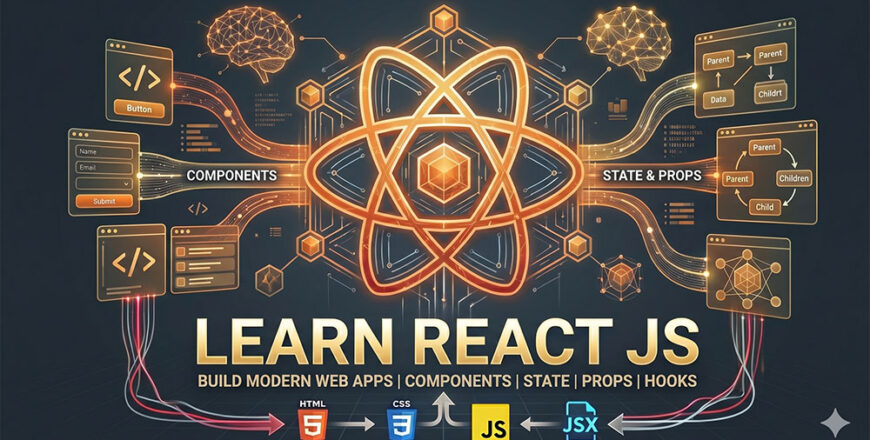
Welcome to Fullstack Web Development – Learn React, a premier, self-paced, and text-based mastery program delivered by Generiss Academy. If you are tired of passive video tutorials that drag on and prefer a structured, deep-reading format where you can analyze complex architecture and execute live code templates at your own speed, this curriculum is built for you.

React remains the uncontested industry titan for building dynamic, high-performance web applications. In this course, we demystify the declarative paradigm of UI engineering. You will transition from basic static web elements to designing advanced, component-driven architecture using functional components, state synchronization, custom Hooks, dynamic client-side routing, and complex data-fetching layers.

Through meticulously written documentation, step-by-step technical blueprints, and rigorous source-code breakdowns, you will master the front-end ecosystem used by engineering heavyweights like Meta, Netflix, and Airbnb.

Creative Commons Notice

This course description and its associated text-based syllabus material are licensed under a Creative Commons Attribution-NonCommercial-ShareAlike 4.0 International License (CC BY-NC-SA 4.0).

How does a "text-based" format work for React?
Instead of copying code blocks from a running video player, you learn directly by reading deeply detailed, structural documentation modules. It mirrors how professional software engineers learn on the job—by reading clean specifications, dissecting annotated code sandboxes, and evaluating component hierarchy trees.
Why should I choose React over other frameworks like Angular or Vue?
React enjoys an incredibly massive market share, an expansive community pool, and a booming ecosystem of supplementary tools. Choosing React offers a higher volume of open tech roles, an easier entry path into mobile code via React Native, and an incredibly strong network effect for engineering assistance.
Is this course updated with modern React concepts?
Yes. This curriculum completely skips obsolete class-based components. You will focus exclusively on modern Functional Components, React Hooks (useState, useEffect, useMemo), Context API, and modern best practices for clean component extraction.
Do I need back-end engineering experience to take this course?
Not at all. While React can connect to any backend database or server application through HTTP/Fetch requests, this curriculum focuses explicitly on mastering the browser environment and front-end state architecture.
What sort of applications will I build during the reading modules?
You will move from basic component rendering to interactive tools, starting with client-side state managers (like advanced tracking dashboards), shifting into API-integrated apps (like dynamic movie libraries or weather dashboards), and concluding with a complex, route-protected dashboard system.
How do I troubleshoot bugs or runtime issues if I get stuck?
Even though the pathway is self-paced, you are fully backed by the Generiss Academy platform. You will gain direct entry into a technical developer forum space where you can paste your React components, display your terminal error traces, and collaborate with mentors and fellow engineers to resolve blocks.
Do I receive an industry certificate upon completion?
Yes. Once you read through all technical modules, clear the module challenge checkpoints, and verify your code assemblies, you will receive an official Generiss Academy Certificate of Completion formatted for resumes and LinkedIn sharing.

Course Duration

Because the curriculum is 100% self-paced, your timeline is entirely up to your personal schedule:

  • Total Content Volume: Roughly 55 to 75 hours of core documentation readings, live-code rendering labs, and asynchronous project assemblies.

  • Recommended Velocity: Committing 5 to 8 hours per week will allow you to comfortably process the text material and finish the entire framework pathway in 9 to 11 weeks.

  • Access Lifespan: Enrolling grants you lifetime access to all core text modules and engineering guides, functioning as a persistent reference library for your career.

Career Paths, Roles, and Opportunities

React is arguably the most dominant keyword across modern web engineering job boards. Specializing in this framework sets up a direct track to multiple technical domains:

Modern Job Roles
  • React Developer / Front-End Engineer: Specializing strictly in UI optimization, responsive interfaces, component states, and browser-side speed enhancements.

  • Fullstack JavaScript Engineer: Implementing React on the user interface while seamlessly linking it with Node.js/Express or serverless cloud backends.

  • UI/UX Engineer: Serving as the direct link between raw design wireframes and production-ready interactive browser code.

  • Client-Side Solutions Architect: Overseeing complex multi-page applications, design systems, global state patterns (Redux/Context), and client-side data pipelines.

Current Salaries (UK & US)

Reflecting data across tech hubs in the current market, engineering expertise in the React ecosystem commands top-tier compensation packages.

Region Experience Level Average Annual Salary Range United Kingdom (UK) Junior / Graduate Engineer £35,000 – £45,000 Mid-Level React Developer £50,000 – £75,000 Senior Engineer / Tech Lead £80,000 – £110,000+ United States (US) Junior / Graduate Engineer $75,000 – $95,000 Mid-Level React Developer $100,000 – $135,000 Senior Engineer / Tech Lead $145,000 – $185,000+
Get course
Available with Memberships
Buy Course
Course details
Duration 60 hours
Lectures 27
Level Intermediate
Course requirements

To ensure a smooth and successful progression through this text-based program, you will need to meet the following baselines:

  • Prerequisites: A solid foundational understanding of HTML, CSS, and modern JavaScript (ES6+). Comfort with concepts like arrays, arrow functions, object destructuring, and asynchronous JavaScript (Promises/Fetch) is critical.

  • Hardware: A desktop computer or laptop (macOS, Windows, or Linux layout) capable of running modern development software.

  • Software: A flexible integrated development environment (IDE) like Visual Studio Code, a terminal shell interface, and a modern web browser with developer tool capabilities (such as Google Chrome or Firefox).

  • Internet Connection: A reliable internet connection to access text modules, download third-party libraries via npm/yarn, and render deployment sandboxes.

Intended audience

This course eliminates the fluff of video-based hand-holding, making it ideal for self-directed, text-oriented learners, including:

  • Front-End & UI Enthusiasts wanting to upgrade from vanilla JavaScript to component-based single-page application (SPA) architectures.

  • Back-End Developers trying to gain full-stack autonomy by dominating the browser landscape with modern React layouts.

  • Technical Re-skillers & Bootcamp Grads who feel video courses move too slowly or skim over deep architectural concepts like re-rendering cycles and state mutation.

  • Independent Problem Solvers who excel at reading official technical documentation, debugging source code, and working asynchronously.