Python for Data Analysis


- Description
- Curriculum
- FAQ
- Notice
- Reviews
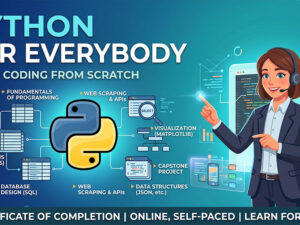
Welcome to Introduction to Python for Data Analysis! In this course, you will embark on a journey to learn one of the most versatile and powerful programming languages for data analysis – Python.
Designed specifically for beginners with no prior programming experience, this course will provide you with a solid foundation in Python programming concepts and techniques tailored for data analysis tasks.
Through a series of interactive lessons and hands-on exercises, you will learn how to manipulate data, perform basic analysis, and visualize insights using Python’s powerful libraries. By the end of the course, you’ll be equipped with the essential skills to start your journey into data analysis with Python.
Overall Course Objectives:
- Understand the fundamentals of Python programming and data structures.
- Learn essential libraries for data analysis: pandas, NumPy, Matplotlib, Seaborn.
- Master data manipulation, cleaning, and exploration techniques.
- Perform descriptive and inferential statistics.
- Create compelling data visualizations to communicate insights.
- Implement basic machine learning algorithms for prediction and analysis.
Upon completing a Python for Data Analysis course, students can pursue various career paths in the data science and analytics domain. Here are some potential career paths:
-
Data Analyst: Data analysts utilize Python programming skills to clean, preprocess, analyze, and visualize data. They work with large datasets to extract meaningful insights and trends, aiding in decision-making processes within organizations.
-
Data Scientist: Data scientists leverage Python for data exploration, predictive modeling, and machine learning tasks. They develop algorithms and statistical models to solve complex business problems and uncover actionable insights from data.
-
Business Intelligence Analyst: Business intelligence analysts use Python to extract and transform data from multiple sources, creating reports, dashboards, and visualizations. They analyze data to identify trends, patterns, and opportunities for improving business performance.
-
Machine Learning Engineer: Machine learning engineers build and deploy machine learning models using Python libraries such as Scikit-learn and TensorFlow. They work on developing algorithms that can learn from data and make predictions or decisions autonomously.
-
Data Engineer: Data engineers design and maintain data pipelines and infrastructure using Python. They work with big data technologies such as Apache Spark and Hadoop to process and store large volumes of data efficiently.
-
Quantitative Analyst (Quant): Quants apply Python for financial modeling, risk analysis, and algorithmic trading strategies. They use Python libraries such as Pandas and NumPy to analyze financial data and develop quantitative models for trading and investment purposes.
-
Research Scientist: Research scientists use Python for data analysis and modeling in academic or industry research settings. They conduct experiments, analyze results, and develop algorithms to advance scientific knowledge in fields such as healthcare, biology, or environmental science.
-
Business Analyst: Business analysts use Python to analyze customer behavior, market trends, and competitor performance. They apply statistical analysis and data visualization techniques to provide insights and recommendations for business strategies and decision-making.
-
Consultant: Data science consultants work with clients from various industries to solve complex problems using Python and data analysis techniques. They develop custom solutions, conduct data-driven analyses, and provide actionable insights to drive business outcomes.
-
Freelancer/Contractor: With expertise in Python for data analysis, individuals can work as freelancers or contractors, offering their services to clients on short-term projects or consulting engagements. They have the flexibility to work on a variety of projects across different industries.
These are just a few examples of the diverse career paths available to individuals with Python skills for data analysis. The field of data science continues to grow, offering ample opportunities for professionals to apply their expertise and make a significant impact in various domains.